What Actually Happens Inside a 3D Printer (Physics Behind It)
April 14, 2026 · 11 min read ★ Featured
Written byWilliam RizzoWR
Most people who use 3D printers have never really thought about what the machine is doing between 'send to print' and 'part ready.' That gap matters more than you'd expect. Here's what's actually happening and why the physics should change how you design.
The Core Idea
One process, transferable logic
This post focuses primarily on FDM (Fused Deposition Modelling), the most widely used AM technology, because its mechanics are the most visible and intuitive. The specific details change across technologies, but the core questions (how does material solidify? how do layers bond? where does anisotropy come from?) apply to all of them. Build this foundation and the others become much easier to reason about.
The Mental Model
Starting material state, transition mechanism and final state across technologies.
How It Actually Works
SEM cross-section of raster layers showing the flattened oval filament geometry and small voids between adjacent beads. Source: Dissemination of IT for the Promotion of Materials Science (DoITPoMS)
The strength of that bond is affected by several variables: nozzle temperature, print speed, layer height, and the specific material. Print too fast, and the new bead cools before it can properly diffuse into the layer below. Print too cold, and the bonding zone never softens enough. Get the parameters right, and the bond approaches (but never quite reaches) the strength of the bulk material.
AM is not a prototyping-only technology
A persistent misconception is that AM is suitable for models and mockups but not for end-use parts. In aerospace, medical devices, and high-performance motorsport, AM-produced components are flying, implanted, and racing right now. The distinction isn't prototype vs production: it's understanding which parts benefit from the geometry freedom AM offers, and which don't.
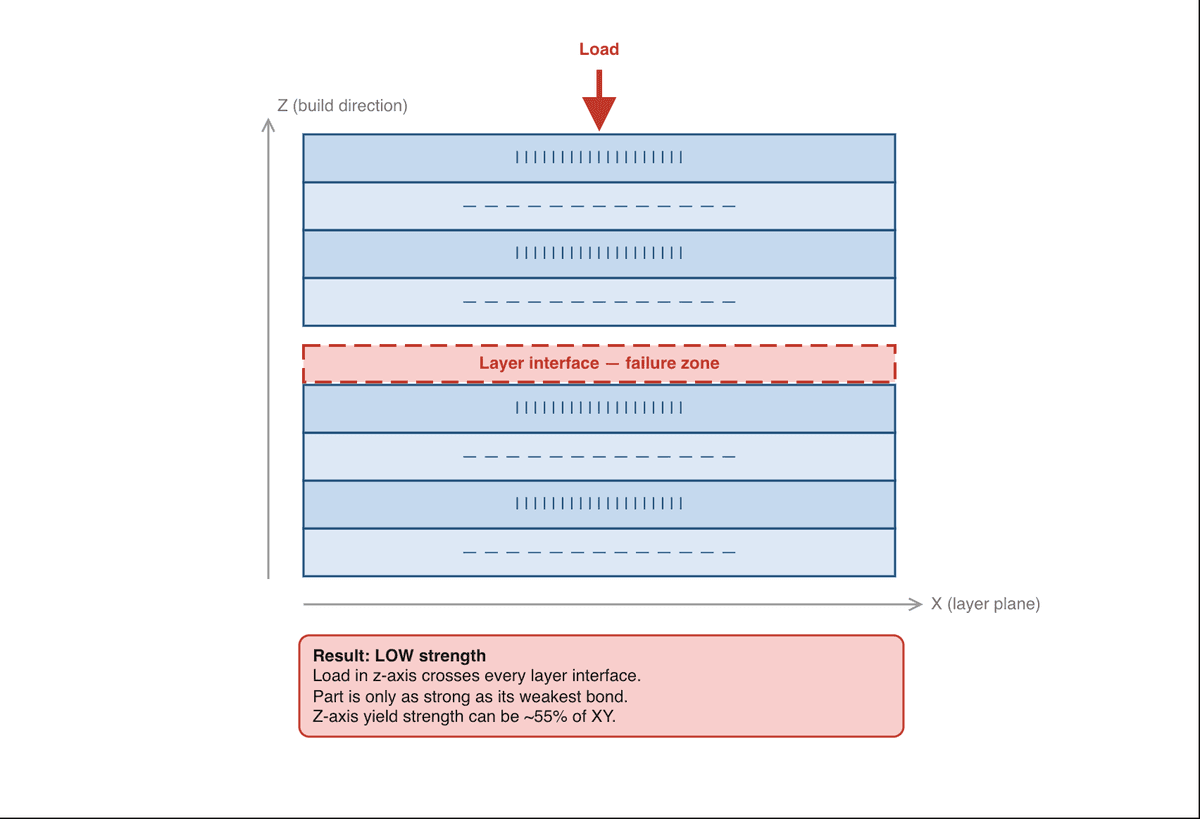
Anisotropy in FDM parts. Orientation on the build plate is a structural decision. The same part geometry can be strong or weak depending purely on how it is positioned.
Where It Gets Interesting
“Once you understand the phase transition, every design decision in AM becomes a thermal or chemical argument. The geometry is the surface. The physics is what's underneath it.”
There's a moment that happens to almost everyone the first time they watch a 3D printer run. You stand there, looking at the build platform, watching a nozzle trace slow loops over a thin layer of material. And you feel like you understand what's happening. It looks almost obvious. The part is being drawn, layer by layer, into existence.
Then the print fails. Or comes out weaker than expected along one axis. Or the surface finish is rougher than it should be. Or the internal geometry you designed doesn't quite match what you got. And the intuitive sense that you understood the process quietly evaporates.
The truth is that most people who operate 3D printers, including many engineers, carry a mental model of the process that stops at "it prints layers." What actually happens at each layer, the thermal dynamics, the bonding mechanisms, the material behaviour under deposition, is where the real story lives. Understanding it doesn't just satisfy curiosity. It directly shapes how you design, what you expect, and how you interpret when something goes wrong.
This post is about that inside view. One process (FDM) in enough depth to build real intuition, with the broader principles that carry across the technology families we'll cover in post three.
Every AM process, regardless of technology, is solving the same fundamental problem: how do you reliably build a solid, functional three-dimensional object from nothing, one thin cross-section at a time?
The answer sounds simple. You deposit material in each cross-section, let it solidify, then move to the next layer. Repeat until you have a part.
But "deposit" and "solidify" are doing an enormous amount of work in that sentence. The specific mechanics of how a process deposits material and how that material transitions from soft or liquid to solid determines almost everything you care about as a designer: how strong the part is, where it's weak, what geometries are achievable, what surfaces look like, what tolerances you can hold, and how long the build takes.
The layer-by-layer logic is the same across AM technologies. The physics underneath it are completely different depending on whether you're melting polymer filament, curing resin with UV light, or fusing metal powder with a laser. Each set of physics brings its own design implications. And you can't reason about those implications without understanding what's actually happening at the material level.
The most useful frame for thinking about any AM process is the phase transition: what state is the material in when it's deposited, and what state does it need to reach for the part to be functional?
In FDM, a solid thermoplastic filament is heated past its glass transition temperature, turning it into a viscous semi-liquid. The machine extrudes this material through a nozzle and deposits it precisely onto the build surface. The material then cools rapidly, re-solidifying and (ideally) bonding to the layer below. The build platform drops slightly, and the next cross-section is deposited on top.
In stereolithography (SLA), liquid photopolymer resin is exposed to a UV laser. The light triggers polymerisation, a chemical reaction that converts the liquid monomer into a solid polymer. No heat involved; the phase transition is chemical rather than thermal.
In selective laser sintering (SLS) and its metal equivalent (SLM/DMLS), a bed of fine powder is selectively fused by a laser. The powder particles melt locally and re-solidify into a solid mass.
What this frame gives you is a way to reason about every process from first principles. The phase transition determines the bonding mechanism, and the bonding mechanism determines where the part is strong, where it's vulnerable, and what kinds of geometry it can reliably produce.
This is the one model worth carrying forward: AM is a process of repeated, controlled phase transitions. Everything else, layer adhesion, anisotropy, surface finish, support requirements, follows from the specific nature of those transitions in whatever process you're using.
Let's make FDM concrete, because the details matter and they're not obvious from watching the machine run.
The filament feed system pushes solid thermoplastic (typically PLA, ABS, PETG, nylon, or a composite) into a heated block called the hot end. By the time the material reaches the nozzle tip, it's been brought to a temperature above its glass transition: soft enough to flow, not liquid enough to run. The nozzle moves through a programmed path, extruding a continuous bead of material roughly 0.4mm wide (for a standard nozzle). This bead is the basic building block of the part.
The bead is deposited on the layer below, which has already cooled and re-solidified. The fresh bead is hotter than the layer beneath it. For a fraction of a second, the two materials are in contact at different temperatures. Heat flows from the new bead into the cooled layer below. At the interface, the surface of the previous layer briefly softens. The two materials diffuse slightly into each other. Then both cool and re-solidify.
That interface is the layer bond. And it is almost always the weakest point in the part.
This is the origin of anisotropy in FDM parts: the mechanical property of being stronger in some directions than others. A part printed with layers stacked vertically will be significantly weaker in the Z direction (perpendicular to the layers) than in X or Y (along the layer plane). The load is carried differently depending on how it relates to the layer orientation. This isn't a defect or a calibration problem. It's a structural consequence of the process physics. Designing around it requires knowing it exists.
Here is the thing that unlocks AM for serious design work: once you understand the phase transition and the bonding mechanism, you can reason about why parts behave the way they do rather than just observing that they do.
Take support structures. In FDM, material can't be deposited in mid-air. There's nothing beneath it to build on as it exits the nozzle. Any geometry that overhangs beyond a certain angle (typically around 45°) needs a support structure printed beneath it to give the material something to land on. That support is later removed, leaving a surface that's rougher than the surfaces that printed against air.
Understanding the phase transition tells you immediately why this is true. The extruded bead needs a substrate to transfer heat into and bond with. Without one, it sags, curls, or drops. The 45° rule isn't arbitrary. It's the approximate angle at which the previously deposited material still provides enough lateral support to carry the new bead. Above that angle, you're asking the bead to bridge a gap it can't reliably span.
The same logic explains why cooling matters so much in FDM. Faster cooling between layers means less time for diffusion at the bonding interface, which means weaker layer bonds. Slower cooling (or active temperature management in enclosed printers) gives the bonding zone more time to form, which improves Z-direction strength but can cause other issues, like warping in materials with high thermal contraction, when layers at different temperatures fight each other as they cool.
variables that directly affect material behaviour at the layer interface. The same geometry at the same layer height will produce a meaningfully different part at different temperatures and speeds. An engineer who understands why can tune parameters to get the result they need. One who doesn't is just adjusting numbers and hoping.
The same analytical frame carries into other AM processes. In SLA, the UV exposure dose and cure depth determine how far the polymerisation reaction penetrates into the resin, which affects the bond between adjacent cure zones. In SLS, the laser power and scan speed determine how completely the powder particles fuse, which sets the density and strength of the sintered part. Different physics, same logical structure: understand the transition, and the rest follows.
Think about how a dry stone wall is built.
No mortar. The wall holds together through the weight of each stone pressing on the ones below, and through the careful interlocking of shapes across layers. Get the placement right, and the wall is surprisingly strong. Place a stone badly, wrong angle, wrong overlap, and the wall fails at that joint, not anywhere else.
An FDM part works on a similar principle. Each layer is a course of stones. The bond at each interface is the joint. The overall strength of the part in any given direction is determined not by the bulk material but by the quality and orientation of those joints. A wall is as strong as its weakest course. A printed part is as strong as its weakest layer bond under the load it actually experiences.
The mason who understands this builds differently to one who doesn't. They plan the courses before they place the first stone. They think about where loads will travel. They put the longest, flattest stones at the base, not the middle.
The AM designer who understands layer bonding thinks the same way. Not about what the part looks like, but about how the layers will carry the load.
Every AM process is built around a repeated phase transition: material moves from one state to another to form each layer, and the nature of that transition defines the process's properties and limitations
In FDM, the layer bond forms when a hot extruded bead briefly re-melts the cooled surface below it. That bond is the structural weak point of any FDM part
Anisotropy in FDM, the directional difference in strength, is a fundamental consequence of the process, not a calibration error. It must be designed around, not ignored
Print parameters (temperature, speed, layer height) are process variables that directly affect material behaviour at the bonding interface. They should be understood, not just adjusted by feel
Support structures exist because material can't be deposited in mid-air: the geometry of overhangs is a direct consequence of the bonding mechanics
The same logical framework (phase transition, bonding mechanism, mechanical properties) applies across all AM technologies. Build the model in FDM and you have a foundation for understanding all of them
Next week we pull back from the physics of one process and map the whole landscape: the main AM technology families, what makes each one genuinely different, and how to think about which belongs in which situation, without the marketing hype that usually surrounds that question.