The Main Additive Manufacturing Technologies (Without the Hype)
April 21, 2026 · 10 min read ★ Featured
Written byWilliam RizzoWR
The Core Idea
Not a hierarchy
The Mental Model
FDM vs SLA surface quality comparison
DLMS optimised design and quality
How It Actually Works
The SLS misconception
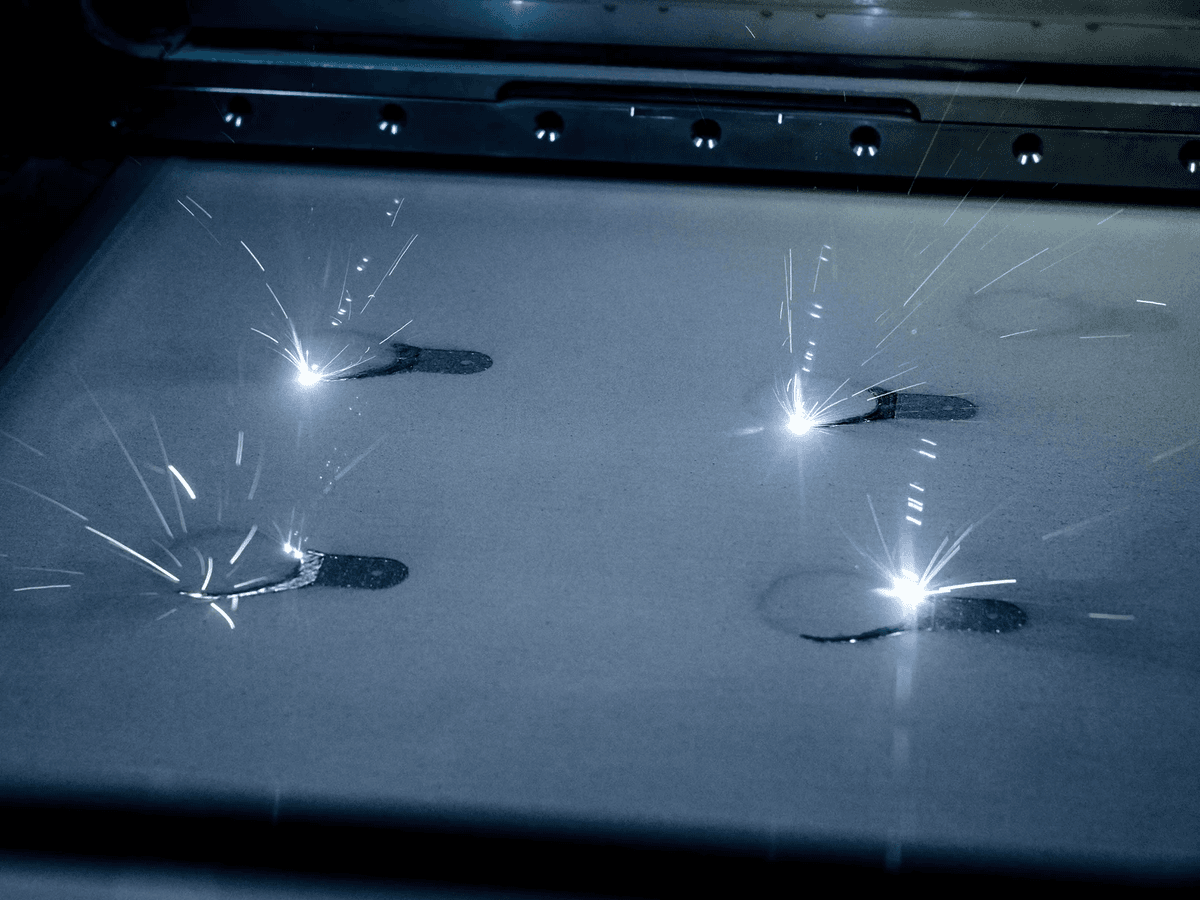
Example of process phases during additive manufacturing: material deposition for FDM, UV exposure for SLA resin, UV powder curing for SLS and laser melting of metal layer.
Where It Gets Interesting
“The hype around metal AM is earned. So is the caution. It can make parts no other process can. It can also make a six-figure mistake feel deceptively easy to produce.”
FDM, SLA, SLS, metal AM. Most comparisons put them in a table and pick a winner. That framing is useful for buying a desktop printer and actively misleading for anything else. Here is what actually separates them and why the consumer/industrial divide matters more than any spec sheet.
Walk into a Makerspace and walk into a SpaceX production facility. Both rooms contain additive manufacturing equipment. Both rooms have engineers making decisions about layer height and build orientation. And that is roughly where the similarities end.
The consumer 3D printing world and the industrial AM world share a name, a few underlying physical principles, and almost nothing else. Different machines, different materials, different tolerances, different economics, different failure modes, and different definitions of what "good" even means. Calling them the same field is a little like calling a home kitchen and a pharmaceutical manufacturing plant the same because both use heat to change the state of matter.
This post covers the main technology families: FDM, SLA and DLP, SLS, and metal AM. Not as a comparison table, not as a buyer's guide, but as an argument. The argument is that you cannot understand these technologies without understanding which world they belong to, and that most people are reasoning about industrial AM using intuitions they built in the consumer one.
The standard AM technology overview goes something like this: here are the main processes, here is how each one works, here is a table comparing resolution and cost and material options. Pick the one that fits your project.
That framing is useful for buying a desktop printer. It is actively misleading for anything else.
The real distinction in AM is not between process families. It is between two fundamentally different contexts of use. In one context, you are making one-off objects, prototypes, hobbyist parts, maybe small-batch products where fit and feel matter more than mechanical performance. In the other, you are making functional components that go into assemblies, carry loads, interface with other parts, and have to do all of that reliably across hundreds or thousands of units.
The technologies that dominate each context are different. The design rules are different. The way you think about failure is different. And perhaps most importantly, the way you evaluate a technology's capabilities is different.
This is not a hierarchy. Consumer AM is not a lesser version of industrial AM. They are optimized for different things. The problem is when people borrow mental models from one context and apply them in the other, which happens constantly and usually invisibly.
Here is a useful way to organize the landscape. Instead of thinking about technologies as a flat list of options, think of them as sitting on two axes: surface quality versus structural integrity.
Consumer AM largely trades structural integrity for surface quality and accessibility. You can make something that looks right, quickly and cheaply. Whether it holds up under load, maintains dimensional accuracy over time, or performs consistently across a batch is a secondary concern if it matters at all.
Industrial AM runs that tradeoff in reverse. A turbine bracket does not need to look good. It needs to be exactly the right shape, made of the right material, with the right grain structure, tolerant of the thermal and mechanical loads it will encounter in service. Surface finish is something you address in post-processing. Structural performance is non-negotiable.
This matters because the technologies that are excellent at one end of that axis are often mediocre or irrelevant at the other. A technology that produces beautiful surface finish in consumer-grade photopolymer is not the same technology, philosophically or practically, as one that sinters aerospace-grade nylon for flight hardware. And a technology that fuses metal powder into load-bearing components has almost no meaningful relationship to the FDM printer on someone's desk.
The framework: before evaluating any AM technology, ask which axis it is optimizing for, and whether that matches what your application actually requires.
FDM (Fused Deposition Modeling): the consumer default
FDM is what most people mean when they say 3D printing. A heated nozzle extrudes thermoplastic filament and traces each layer's cross-section. The material cools, bonds to the layer below, and the process repeats until the part is done.
It is accessible, fast to set up, and cheap to operate. It is also anisotropic by nature: parts are stronger along the XY plane than in the Z direction, because the layer bonds are weaker than the material itself. Overhangs require support structures. Surface finish is defined by layer lines, which you can minimize but not eliminate without post-processing. Material options are wide and growing, but the majority of functional FDM work still uses PLA, PETG, ABS, or nylon.
FDM lives almost entirely in the consumer and prototyping world. There are industrial FDM machines, and some are used for tooling and fixtures in manufacturing environments. But the process physics impose limits that are difficult to engineer around at scale.
SLA and DLP: the consumer premium
SLA uses a UV laser to cure photopolymer resin layer by layer. DLP (Digital Light Processing) does the same thing with a different energy source: instead of a scanning laser, a digital light projector exposes the entire layer at once using a pixel grid. Newer MSLA printers use an LCD masking layer in front of a UV backlight to achieve similar results at lower cost.
The practical difference between SLA and DLP is mostly about speed and resolution tradeoffs. SLA's laser traces each feature precisely, making it strong for fine detail. DLP exposes the full layer in one shot, making it faster at the cost of some resolution at the pixel boundary. For most professional use cases the distinction is narrower than the marketing suggests, and both processes share the same fundamental limitation: photopolymers are brittle, UV-sensitive over time, and not the right material for structural parts under sustained load.
SLA and DLP sit firmly in the consumer and design-prototype segment, where visual and tactile quality matter more than mechanical performance. The technology is evolving fast, particularly on the DLP and MSLA side, but the material constraints are a physics problem more than an engineering one.
SLS (Selective Laser Sintering): the bridge
SLS is where the consumer/industrial divide starts to blur. A laser selectively sinters layers of polymer powder, most commonly nylon. The unsintered powder surrounding the part supports it during the build, which means SLS can produce geometries that FDM and SLA cannot: interlocking assemblies, internal channels, complex organic forms, all in a single build.
The resulting parts have significantly better mechanical properties than FDM or SLA equivalents, closer to isotropic, and the absence of support structures removes a major post-processing step. SLS parts come out of the powder cake looking matte and slightly rough, but they behave more like injection-molded components than anything you would produce on a desktop printer.
Because SLS is support-free, designers sometimes assume build orientation does not matter. It does. Powder flow, thermal gradients, and packing density all affect part quality in ways that are orientation-dependent. SLS freedom is geometric, not unconditional.
SLS is expensive. The machines require controlled environments, the powder handling has safety considerations, and the per-part economics favor service bureaus over in-house ownership unless volumes are high. But SLS is where AM starts to take on industrial character: parts that go into real products, carry real loads, and have to hold up over time.
The consumer/industrial framing clarifies something that technology comparisons usually obscure: the upgrade path is not linear.
In software, there is usually a meaningful sense in which a more powerful tool is also a more complex version of a simpler one. You learn Python, then you learn to write efficient Python, then you learn to build systems in Python. The mental model scales.
AM does not work that way. The intuitions you build designing for FDM will actively mislead you when you move to SLS. The tolerances, the support strategy, the material behavior, the post-processing requirements, the failure modes: all different. And the intuitions you build in SLS will mislead you again when you move to metal AM, where the thermal behavior of the build, the residual stresses in the part, and the relationship between geometry and process are different again.
This is not a reason to avoid learning across the stack. It is a reason to treat each transition as starting from scratch, rather than as leveling up.
The other thing worth noting is that most publicly visible AM discourse lives in the consumer half of the divide. The accessible machines, the enthusiast community, the YouTube tutorials: all FDM and SLA, with some SLS coverage appearing in professional circles. Metal AM has a much smaller, more specialized community, and most of the real knowledge lives inside aerospace primes, medical device companies, and a handful of specialist service bureaus.
If you are reasoning about what AM can and cannot do based on what you have read online, there is a reasonable chance you are reasoning about the consumer half of the field and extrapolating to the industrial half. That extrapolation has limits.
Photography used to work this way. There was consumer photography: film cameras, drugstore development, prints for the album. And there was professional photography: medium format, darkroom chemistry, studio lighting, technical precision in service of commercial work.
Both fields used cameras. Both produced images. But the knowledge, the equipment, the economics, and the definition of quality were so different that a skilled amateur photographer could move to professional work and find that almost everything they knew needed to be relearned under different constraints.
AM is at a similar point. The consumer and industrial halves share enough vocabulary and surface-level similarity that the divide is easy to underestimate. It is only when you try to move between them that the gap becomes visible.
FDM and SLA/DLP are consumer-first technologies, optimized for accessibility, speed, and visual quality. They have professional use cases but their fundamental constraints are set by physics that is hard to engineer around.
SLS is the bridge technology: polymer-based, expensive, geometrically powerful, and capable of producing parts with real structural integrity.
Metal AM (DMLS / SLM) is a separate field in almost every meaningful sense. The capability is real. So is the expertise, cost, and process complexity required to use it well.
The consumer/industrial divide is not about machine quality. It is about what the technology is optimized for, and whether that optimization matches your application.
Intuitions built in one half of the divide do not transfer cleanly to the other.
Which raises the question that this series has been building toward: if you are working in the industrial half of this field, how do you actually choose between the technologies available to you? The honest answer is that the technology choice is not really separable from the design choices you make before it. Those constraints, and how to think through them, are what next chapters will talk about.